
Grand Capital
Grand Capital Review 2026: An In-Depth Look at the Offshore Broker
Grand Capital review. In the vast and often opaque world of online forex and CFD trading, choosing a broker is a decision that requires meticulous research. Grand Capital, presents itself as a comprehensive gateway to the financial markets, offering a wide array of assets, platforms, and account types . With a presence in over 144 countries and a growing client base, it has become a recognizable name, particularly in regions like Africa, Asia, and Eastern Europe.
However, a superficial glance at attractive bonuses and low deposit requirements can be misleading. This comprehensive Grand Capital review aims to dissect the broker’s operations with a critical eye, focusing on the realities of its offshore licensing, the true cost of its bonuses, and the mixed experiences of its clientele. For potential traders, understanding that Grand Capital operates under a Tier-3 regulatory framework is not just a footnote but the central theme that dictates the level of risk and protection they assume
We will explore what it means for a broker to be registered in the Comoros, analyze the fine print of promotional offers like the Payback program, and synthesize feedback from across the internet to provide a balanced, factual, and honest assessment.
The goal is to equip you with the knowledge needed to determine if Grand Capital aligns with your trading goals and, more importantly, your risk tolerance.
Grand Capital Review. Company and Market Position
Grand Capital Ltd. has been a participant in the online trading industry since 2006, weathering various market cycles and regulatory shifts . Headquartered in Russia, the broker has positioned itself as a “one-stop-shop” for traders, from absolute beginners to seasoned professionals . It boasts a client base of over 750,000 and has received industry awards, such as “Best Broker in Africa” at the Africa Financial Expo .
The broker’s value proposition is built on several pillars:
- Accessibility: A very low minimum deposit of $10 makes it easy for anyone to open an account .
- Diverse Asset Offering: Clients can trade over 500 instruments, including forex pairs, stock CFDs, indices, commodities, and cryptocurrencies .
- Platform Choice: The industry-standard MetaTrader 4 and MetaTrader 5 are available, alongside a simple proprietary WebTrader .
- Passive Investment Options: Services like copy trading and PAMM accounts allow investors to mimic the strategies of more experienced traders .
While these features are attractive, they are common among many brokers. The true differentiator—and the most critical factor for any trader—lies in the regulatory and security framework underpinning these services.
Grand Capital Review. Offshore Registration and What It Really Means
The most critical section of any broker review is its regulatory status. According to its official website, Grand Capital operates under two key regulatory umbrellas: a license from the Mwali International Services Authority (MISA) and membership in the Financial Commission (FinaCom) . Understanding the practical implications of each is paramount.
The MISA License: A “Shell” Regulation
In 2024, Grand Capital proudly announced it had been granted a license by the Mwali International Services Authority (MISA) on the Autonomous Island of Mwali (Mohéli), part of the Union of Comoros
On the surface, this sounds like a legitimate regulatory endorsement. However, in the world of financial oversight, not all licenses are created equal. MISA is what the industry terms a “Tier-3” regulator . This classification signifies the lowest level of regulatory oversight. Here’s what that actually means for a client:
Minimal Entry Requirements
Obtaining a license in jurisdictions like the Comoros is notoriously easy. The requirements are often basic—pay a fee, submit minimal paperwork, and maintain a registered agent. There is no stringent assessment of the company’s financial health, operational integrity, or the suitability of its management. The LinkedIn announcement from Grand Capital itself frames it as granting the “legal right” to provide services, not as a testament to financial probity
Lack of Active Supervision
Unlike top-tier regulators (like the UK’s FCA or Cyprus’s CySEC) that conduct regular audits, monitor client fund segregation, and enforce strict advertising rules, MISA has no such reputation or capacity. Once the license is issued, there is virtually no ongoing supervision of Grand Capital‘s day-to-day activities. This lack of oversight creates an environment where the broker is essentially a self-regulating entity.
No Investor Protection Fund
Perhaps most importantly, the MISA license does not come with a mandatory investor compensation fund . If Grand Capital were to face insolvency, there is no government-backed scheme to help clients recover their funds. This stands in stark contrast to brokers regulated by top-tier bodies, where clients are often protected up to a certain amount (e.g., €20,000 under CySEC).
In essence, the MISA license is a formality that allows Grand Capital to operate internationally and claim it is “licensed” without having to adhere to the costly and demanding requirements of a major financial regulator . It provides the broker with maximum operational freedom but leaves the client with maximum risk.
Grand Capital Review. FinaCom: A Dispute Mediation Service, Not a Regulator
To bolster its credibility, Grand Capital heavily promotes its membership in the Financial Commission (FinaCom), an independent dispute resolution service it has belonged to since 2016 . The broker states that this guarantees clients protection and assigns it a “Category A” reliability rating with a compensation fund of up to €20,000 per client .
It is vital to understand what FinaCom is and, more importantly, what it is not.
- What it is: FinaCom is an industry-specific alternative dispute resolution (ADR) body. If a client has a dispute with a member broker that cannot be resolved directly (e.g., issues with trade execution, order of fills), they can file a claim with FinaCom. The organization’s Dispute Resolution Committee will then mediate and make a ruling . This is a valuable service, as taking legal action against an offshore company is often impractical for an individual trader. The €20,000 compensation fund is a last-resort payout if the broker fails to comply with a FinaCom ruling .
- What it is NOT: FinaCom is not a regulator. It does not have the authority to conduct audits, enforce capital adequacy requirements, or ensure the segregation of client funds. It cannot inspect Grand Capital‘s books or stop them from engaging in risky business practices. Its role begins after a dispute has already occurred. Experts from Traders Union explicitly state that while FinaCom membership provides an extra layer of recourse, it does not substitute for strong regulatory oversight .
In short, the combination of a MISA license and FinaCom membership creates a safety net that is fundamentally different from that of a top-tier regulated broker. The MISA license offers no proactive protection, and FinaCom offers reactive dispute resolution. The onus of due diligence falls squarely on the trader.
Grand Capital Review/ Analyzing Grand Capital’s Promotions
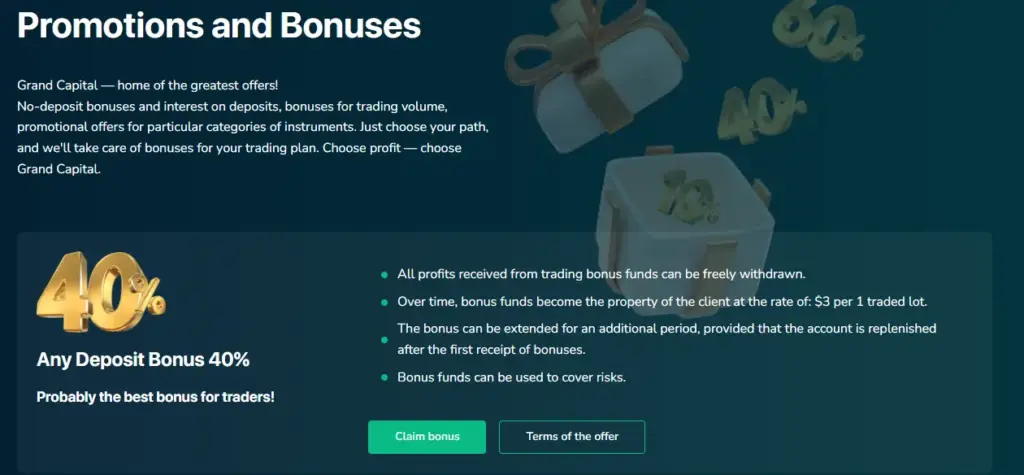
To attract and retain clients in a competitive market, Grand Capital employs a variety of bonuses and loyalty programs. While these can boost trading capital, they are often accompanied by complex terms that can make withdrawing profits difficult.
Deposit Bonuses
Grand Capital frequently offers deposit bonuses, such as a “40% Any Deposit Bonus” . These are classic marketing tools. The appeal is obvious: if you deposit $100, the broker credits an extra $40, giving you $140 to trade with.
The Hidden Conditions: The key to these bonuses is the turning over requirement. While the specific terms can vary and must be checked on the official website, such bonuses typically stipulate that the bonus amount (and sometimes the deposit itself) cannot be withdrawn until a certain trading volume has been achieved. For example, you might need to trade a volume equivalent to 30 or 40 times the bonus amount. This forces the client to trade significantly more than they might have intended, increasing their exposure to market risk and generating more commission for the broker. If a trader makes a profit but fails to meet the volume requirement, the profit may be voided, or the bonus removed upon withdrawal.
The Payback Loyalty Program. Grand Capital Review
The Payback program is a more sophisticated loyalty scheme designed to reward active trading . It works on a “cashback” principle, but with specific triggers:
- Clients receive a cash reward for “active trading days.” An active day is defined as a day where at least one trade is opened and closed, lasting a minimum of five minutes .
- Tiered Rewards: The rewards begin only after five consecutive days of trading. The longer the streak, the higher the reward tier (Bronze, Silver, Gold).
- The “Catch”: The reward calculation is based on the volume traded (lots). To get a meaningful reward, a trader must trade frequently and with significant volume over a long period. This program is designed to cultivate high-frequency trading habits, which can lead to overtrading and increased losses, especially for retail traders.
Cup Trading Tournaments. Grand Capital Review
Grand Capital also runs regular trading tournaments like the “Grand Capital Cup” . These competitions pit traders against each other on demo accounts with a virtual $10,000 balance for a chance to win prizes like an iPhone or deposit bonuses .
- Pros: These contests are a fun, risk-free way for traders to test their strategies in a competitive environment and engage with the broker’s platform.
- Cons: They are primarily a marketing tool to increase user engagement. The prizes are often “deposit bonuses,” which, as noted above, come with their own trading requirements before they can be turned into withdrawable cash.
Grand Capital Review. An Analysis of Client Reviews
Perhaps the most telling indicator of a broker’s reliability is the collective experience of its users. A review of Grand Capital across multiple independent platforms reveals a starkly divided picture, a classic hallmark of brokers with wetted reputations.
Negative Feedback: Common Complaints and Red Flags
The negative reviews are more numerous and point to systemic issues that potential clients should take seriously
Withdrawal Issues: The Primary Complaint
his is the most frequent and serious complaint across forums and review sites like Trustpilot . Clients report:
- Delays: Withdrawals that should take 1-3 days are often delayed for weeks without explanation.
- Rejections and Requests for Documents: Withdrawal requests are rejected based on minor technicalities, with the company requesting new or additional verification documents at the last minute. This creates a “KYC loop” that frustrates clients and delays payouts.
- Profit Confiscation: Some users allege that after making a profit, their accounts were flagged for “violating terms and conditions” (e.g., hedging strategies or using bonus funds in a certain way) and the profits were voided, with only the initial deposit being returned.
- Fees: Clients complain about fees for both deposits and withdrawals, which can eat into profits .
Poor Customer Support
While Grand Capital advertises 24/7 support, user experiences paint a different picture . Complaints include:
- Slow response times, sometimes taking days for a simple query.
- Unhelpful or generic responses that fail to address the specific issue.
- Difficulty reaching support by phone, with a heavy reliance on email or tickets
Aggressive Marketing and Sales Tactics
Some users report receiving frequent calls from personal managers pushing them to deposit more money or invest in certain strategies. This high-pressure sales approach can be off-putting and is a tactic often associated with less scrupulous brokers.
Trading Conditions, Fees, and Accounts
Beyond regulation and reputation, the daily trading environment at Grand Capital has its own set of characteristics that traders must navigate.
Account Types and Minimum Deposits
- Micro Account: Minimum deposit of $10.
- Standard Account: Minimum deposit of $100.
- ECN Prime Account: Minimum deposit of $500.
- MT5 Account: Minimum deposit of $100.
- Crypto Account: Minimum deposit of $100.
- Swap-Free (Islamic) Account: For traders who cannot receive or pay swaps due to religious reasons.
Grand Capital Review. Fee Structure
- Commissions: ECN accounts charge a commission per lot traded. Other accounts may have the commission built into the spread.
- Deposit/Withdrawal Fees: This is a significant drawback. Unlike many modern brokers who absorb these costs, Grand Capital charges fees for both depositing and withdrawing funds, which can be a flat fee or a percentage (up to 2.5%) depending on the payment method . This makes small account trading less economical.
- Inactivity Fees: If your account is idle, be prepared to pay for it.
Leverage and Risk
Leverage and Risk
Grand Capital offers leverage of up to 1:500 and even up to 1:3000, which is exceptionally high. High leverage increases the risk of rapid and complete loss of capital. In reality, high leverage combined with bonuses that encourage overtrading is a dangerous combination for retail traders.
Grand Capital Review. Is Grand Capital the right choice?
This comprehensive Grand Capital review reveals a broker that’s a classic in the offshore forex industry.
The shortcomings are significant and cannot be ignored. The broker’s operations are based on a weak offshore license from the Comoros Islands (MISA), which provides virtually no active protection for clients. The much-touted membership in the Financial Commission is a useful dispute resolution service, but it is no substitute for strong, independent financial regulation. The alarming frequency of client complaints about delays and denials of withdrawals is the biggest warning sign. This suggests that the main difficulty with Grand Capital lies not in trading itself, but in successfully exiting trades and locking in profits. Bonus programs are designed to incentivize large trading volumes, often with complex terms that can trap investors.
Check out broker ratings and reviews on this page. Also read articles in the news section.
More information about Forex broker affiliate programs is available on the website.
Please sign in to your account to leave a review